I attended a reading festival this weekend- on the USF campus in St. Petersburg, Fl- arriving to acclimate with the local literary scene, and to seek advice from fellow authors who had come to market their ware like scholarly carnival barkers on the college square midway. My escort was the young girl responsible for coining the word dumbifying. She was the one responsible for convincing me to attend the fair.
I often find her Virginia spun charm persuasive. She possesses a natural talent of allowing her conservative appearance to contrast with her Progressive political views, as she expresses her statements with an indigenous allegiance to an Allegheny diction.
"I declare!"
She once twanged upon hearing a comment made by a popular Republican daily radio celebrity.
"Why that man is a menace. He's just catering to the dumbiFYing of Americans!"
Her punch on the third syllable of the fabricated participle seemed effectively satirical. I've often use the term to appropriately acknowledge the current condition of our great society.
We strolled around the Book Fair and examined writers as they sat inside tents, behind folding tables lined with the stacks of their self published aspirations, and piles of their deskjet produced marketing pamphlets. They'd pitch the qualities of their works to the wandering patrons of the literary midway; most of whom had no intentions of buying. They were only there to browse the tables and to fill their complementary cloth bags with giveaway items. It was a scene that seemed to replicate the desperation that has fallen upon our industry.
A few buyers had been sold by the persuasions of the authors, and placed their purchased books among the items of their tote bags. However, most of the writers did not attempt to promote. They sat pensively behind their tables, reading newspapers or magazines, or even copies of their own marketing material: unfulfilled by the public acceptance of their creative ambitions.
An enthusiastic teenager approached me and asked if I was interested in her series of self published works about a mythical world of enchantment. Her face contorted with a look of disappointment when I told her I was not. She seemed disingenuous to the response I gave to her inquiry on the subject my own project.
I later saw her with a man I assumed was her father. He stood with his hands upon her shoulders, speaking to her as she nodded and frowned, gazing towards the ground as if searching for a dropped amulet. Her rather ambitious table top display was not enticing much response and I assumed she was receiving the fatherly, "stick to your convictions," talk.
The scene encouraged me to do the same.
The events of the day were later pondered with deliberation at an evening gathering near the campus. I stood at the side of a rooftop railing on a downtown condominium, drinking wine beneath the glow of a full harvest moon, reflecting with a mostly younger crowd of intellectual relievers. As the night evolved- and the consumption progressed- the opinions began to unleash with forceful conviction. I kept my composure intact, until the discourse turned to the future of the novel and the apathy of enlightenment by the dumbifyed citizens of America. Both topics heightened my subjective dander.
Since the Virginian introduced me to the group as her writer friend, a young chemistry student approached me to say she was currently taking a required course in composition, and was having a hard time understanding allegory. She said her instructor recently had her read a passage of sort and then write a short essay on the revealed symbolism. She was unable to complete the assignment because she had not discovered an implied meaning. She was only able to understand the surface description of the events.
I found her explanation to be allegorical of the state of America. It seems a majority of people are not seeing the implications of our national narrative; they only hear the surface banter.
"Dumbifying; truly dumbifying," was my escorts remark to the young girls statement.
I responded, cordially, by noting my surprise with how a college student was unable to conceive symbolism. The remark irritated her boyfriend, who emphatically insisted creative writing was an ancient art form. He further advised that if I wanted to become a commercially successful author in today's market, I needed to accept the fact that conventional reading material is to be composed to reach an eighth grade reading level. I nearly toppled over the edge of the railing upon hearing this comment, but the catastrophe was prevented by a surprised acceptance of this statement by the Virginian. I stood steadfast to hear her explanation.
Although she would later agree the logic contributes to the Dumbifying of America, she insisted most people cannot isolate to reading for pleasure. They want immediate gratification because time is valuable, and they find their time pondering a novel's implied meaning wasteful.It also becomes disruptive to their routine when the meaning of certain words are unknown. The reader then looses interest and abandons the book. A book is not received to enlighten, she told me, it is read to inform.
I, of course, adamantly disagreed, and began to rage my convictions in defense of the literary novel. Was she suggesting people read to occupy the time between daily activities and episodes of Dancing With the Stars? Was she honestly suggesting self proclaimed authorities who write "know it all books" are replacing the ranks of writers who inspire? Is composing on a eighth grade reading level an accepted standard in the industry?
While catching a second wind I noticed her smile and realized that I had been deliberately provoked. Her southern dialect had successfully veiled the satirical implications of her words.I was gratified by the moment of realization, like a person discovering the meaning of a riddle. It was like the sensation one derives from allegory.
I composed my panicked desperation and felt a unison with those that still crave the sensations from narrative. Although it was too late, I wanted to return to the college square and find the discouraged authors sitting behind the table stacks of their works. I wanted to stand them up, place my hands on their shoulders, and tell them to stick to their convictions!
Monday, October 25, 2010


Friday, October 15, 2010
No Rules, Just Write
Being a new comer to the world of social networking is somewhat like transferring to a new school midyear. One must acclimate to the customs and offer tributary to the ranking social orders. The student must initially guard against self expression and allow the fraternal order to exert the criterion of his advancement. It is certain any deviation to the rules will result in confrontation.
If, however, the transferred student decides to suddenly exercise a subjective voice and speak out against the accepted views of nomenclature, the student must be certain the contrasting opinion is convincingly received. It must be accepted by a portion of the masses- at the moment of the announcement-or a miscalculation will certainly lead to alienation. The unaccepted student will then face further matriculation as an outcast.
There have been occasions, however, when the opinions of a renegade student have reconstructed assigned thinking and abolished uniform disciplines. These deviations often lead to the creation of new social orders. It is rarely seen, but when it happens the results are incredible.
Benson's House depicts many of the pertinent moments- in modern American history- when the rebel attitude effectively challenged protocol and changed the social order. The existence of our pop culture would not be what it is today had it not been for the contributions of inventors like Tom Edison, promoters like John Hammond, and talents like The Beatles. My research leads me to believe these pioneering students held a common dominating thought: there are no rules!
When The Beatles first recorded a demo- for EMI records- they were rejected and told their style did not subscribe to the standards necessary to becoming a successful act. Any first time author surely recognizes this sentiment as the war cry of many literary agents. It gives one pause to think a person- whose job it is to develop potentially worthy talent- told John Lennon he didn't have what it takes to be a successful artist.
I'm certain Paul McCartney would agree: conventional thinking must be challenged to allow for the growth of new ideas and the determent of complacency. If all authors, for instance, subscribed to a specific writing style, in a particular genre- because the ranking social order has established this criterion as one that is necessary to meet the demands of a presumed market- eventually all projects would become trite and mediocrity would prevail. The complexion of the nonconformist's thought would not allow for this to happen, because these students deliberately circumvent the rules by acknowledging their insignificance.
I think if any of the rebel students were to council me on my progression as an author they would uniformly declare-
"there are no rules, just write."
There is, of course, a necessity to an abide by the elements of style, unless one's objective is convicted to changing syntax. I'm sure the rebel's would also encourage this attempt as long as the pursuer remembers that a portion of the masses must accept the diviation or the student faces certain alienation.
Just write; find the muse!
I live to be typing in the early morning hours, when the glow- reflecting from my laptop- provides the only light in the room. One falls into the perpetual now. No other dimensions exist; no thoughts emerge except those expressed in text. Then, when the meditation is disturbed by morning light, or a phone call alerting me to return to reality, I realize I'm still captive in time and space, and the perpetual now is abandoned until another session. No rules apply when encapsulated in the now. The formulas would restrict the flow of creativity and alter the natural flow of ideas.
By universally accepting this "no rules logic" we can stop the numbing complacency that currently exists in many aspects of our society. To many know-it-all's are stifling the power of originality by the emphatic insistence that their stale ideas provide the solutions to success. I'm not advocating chaotic rational, I'm encouraging challenges to the conventional standards that have gone awry: THINK outside of the box.
Here's a thought defying conventions!
Over the last fifty years, the highest return on investment did not come from the S&P 500, or precious metals, or currencies, or debentures, or real estate, or any other commodity. It came from investments in art. With an average 13.5% annualized return, investments in art outpaced all other compatible returns.
A purchase of a Warhol in the 1960's could be made for a few hundred dollars. That investment today is worth millions. A 1977 signed first edition of Stephen King's The Shining- with a date code of R49- could have been purchased for $9.00. 33 years later that signed book is worth $2000.00.Think of it! Had an investor been able to have Stephen King sign 1000 copies of his purchased The Shining first edition, that $9000.00 investment would be worth $2,000,000.00 today.
So why is Barnes and Noble selling when the owners are sitting on a potential investment chain whose advisement could provide better returns than the advice given at a Merrill Lynch office across the street? Why is the publishing industry claiming their markets are abating, when they should be expanding their catalogs with unique long term projects and not catering to quick placed schemes? Why aren't they attempting to convince a market that the long term investment in their product- academically or otherwise- will yield high returns?
It is because we as a society are being manipulated into accepting the ideologies of certain ranking orders. We are being convinced their efforts will benefit our existence, when in reality we are only contributing tributary to their ranking social order.
Be a rebel; change the world: we need it now!
I'd like to close reflecting on the controversy of last week. My post dated 9/30/10: Lower West Side Story , stirred criticism for being insensitive to those offended by the development of a Muslim Mosque being built 2 blocks from the site of the World Trade Center attack. My intentions where not to offend, but to denounce those that are using this media exploited incident as a bully pulpit for the advancements of their political agendas.
I stand by that conviction.
I understand the intention of this blog is to endorse the publication of my novel Benson's House, and that any deviation could be perceived as negative and affect the intended outcome of my endeavors. However, my novel- as well as the content of my blog- is an attempt to inspire the enlightenment of the common man.
There are many Muslim Americans, living in the lower west side of Manhattan, who adamantly opposed the tactics of the radicals of their own religion who attacked our country. They were also exposed to the violent violation on that day, and had lost loved ones in the outcome of those fanatical attacks. Their loses should also be agonized and their patriotism to America should be understood.
I'm reminded of a Jon Stewart commentary. He said that from his apartment in Manhattan, he had a view of the twin towers until 9/11. When the buildings collapsed, and the dust settled, instead, from his window, he had a clear view of The Statue of Liberty standing in New York Harbor.
I've often used that comment as a metaphor of what transpired from that- agreed upon- horrific day. On the outcome of that national disaster, a symbol was left standing in the distance. Her torch directs everyman to "the shining city on the hill...teeming with people of all kinds living in harmony and peace."
I leave you all with the words of the sonnet inscribed on a bronze plague placed inside the base of that incredible monument.
The New Colossus
Not like the brazen giant of Greek fame,
With conquering limbs astride from land to land;
Here at our sea-washed, sunset gates shall stand
A mighty woman with a torch, whose flame
Is the imprisoned lightning, and her name
Mother of Exiles. From her beacon-hand
Glows world-wide welcome; her mild eyes command
The air-bridged harbor that twin cities frame.
"Keep, ancient lands, your storied pomp!" cries she
With silent lips. "Give me your tired, your poor,
Your huddled masses yearning to breathe free,
The wretched refuse of your teeming shore.
Send these, the homeless, tempest-tost to me,
I lift my lamp beside the golden door!"
Emma Lazarus
If, however, the transferred student decides to suddenly exercise a subjective voice and speak out against the accepted views of nomenclature, the student must be certain the contrasting opinion is convincingly received. It must be accepted by a portion of the masses- at the moment of the announcement-or a miscalculation will certainly lead to alienation. The unaccepted student will then face further matriculation as an outcast.
There have been occasions, however, when the opinions of a renegade student have reconstructed assigned thinking and abolished uniform disciplines. These deviations often lead to the creation of new social orders. It is rarely seen, but when it happens the results are incredible.
Benson's House depicts many of the pertinent moments- in modern American history- when the rebel attitude effectively challenged protocol and changed the social order. The existence of our pop culture would not be what it is today had it not been for the contributions of inventors like Tom Edison, promoters like John Hammond, and talents like The Beatles. My research leads me to believe these pioneering students held a common dominating thought: there are no rules!
When The Beatles first recorded a demo- for EMI records- they were rejected and told their style did not subscribe to the standards necessary to becoming a successful act. Any first time author surely recognizes this sentiment as the war cry of many literary agents. It gives one pause to think a person- whose job it is to develop potentially worthy talent- told John Lennon he didn't have what it takes to be a successful artist.
I'm certain Paul McCartney would agree: conventional thinking must be challenged to allow for the growth of new ideas and the determent of complacency. If all authors, for instance, subscribed to a specific writing style, in a particular genre- because the ranking social order has established this criterion as one that is necessary to meet the demands of a presumed market- eventually all projects would become trite and mediocrity would prevail. The complexion of the nonconformist's thought would not allow for this to happen, because these students deliberately circumvent the rules by acknowledging their insignificance.
I think if any of the rebel students were to council me on my progression as an author they would uniformly declare-
"there are no rules, just write."
There is, of course, a necessity to an abide by the elements of style, unless one's objective is convicted to changing syntax. I'm sure the rebel's would also encourage this attempt as long as the pursuer remembers that a portion of the masses must accept the diviation or the student faces certain alienation.
Just write; find the muse!
I live to be typing in the early morning hours, when the glow- reflecting from my laptop- provides the only light in the room. One falls into the perpetual now. No other dimensions exist; no thoughts emerge except those expressed in text. Then, when the meditation is disturbed by morning light, or a phone call alerting me to return to reality, I realize I'm still captive in time and space, and the perpetual now is abandoned until another session. No rules apply when encapsulated in the now. The formulas would restrict the flow of creativity and alter the natural flow of ideas.
By universally accepting this "no rules logic" we can stop the numbing complacency that currently exists in many aspects of our society. To many know-it-all's are stifling the power of originality by the emphatic insistence that their stale ideas provide the solutions to success. I'm not advocating chaotic rational, I'm encouraging challenges to the conventional standards that have gone awry: THINK outside of the box.
Here's a thought defying conventions!
Over the last fifty years, the highest return on investment did not come from the S&P 500, or precious metals, or currencies, or debentures, or real estate, or any other commodity. It came from investments in art. With an average 13.5% annualized return, investments in art outpaced all other compatible returns.
A purchase of a Warhol in the 1960's could be made for a few hundred dollars. That investment today is worth millions. A 1977 signed first edition of Stephen King's The Shining- with a date code of R49- could have been purchased for $9.00. 33 years later that signed book is worth $2000.00.Think of it! Had an investor been able to have Stephen King sign 1000 copies of his purchased The Shining first edition, that $9000.00 investment would be worth $2,000,000.00 today.
So why is Barnes and Noble selling when the owners are sitting on a potential investment chain whose advisement could provide better returns than the advice given at a Merrill Lynch office across the street? Why is the publishing industry claiming their markets are abating, when they should be expanding their catalogs with unique long term projects and not catering to quick placed schemes? Why aren't they attempting to convince a market that the long term investment in their product- academically or otherwise- will yield high returns?
It is because we as a society are being manipulated into accepting the ideologies of certain ranking orders. We are being convinced their efforts will benefit our existence, when in reality we are only contributing tributary to their ranking social order.
Be a rebel; change the world: we need it now!
I'd like to close reflecting on the controversy of last week. My post dated 9/30/10: Lower West Side Story , stirred criticism for being insensitive to those offended by the development of a Muslim Mosque being built 2 blocks from the site of the World Trade Center attack. My intentions where not to offend, but to denounce those that are using this media exploited incident as a bully pulpit for the advancements of their political agendas.
I stand by that conviction.
I understand the intention of this blog is to endorse the publication of my novel Benson's House, and that any deviation could be perceived as negative and affect the intended outcome of my endeavors. However, my novel- as well as the content of my blog- is an attempt to inspire the enlightenment of the common man.
There are many Muslim Americans, living in the lower west side of Manhattan, who adamantly opposed the tactics of the radicals of their own religion who attacked our country. They were also exposed to the violent violation on that day, and had lost loved ones in the outcome of those fanatical attacks. Their loses should also be agonized and their patriotism to America should be understood.
I'm reminded of a Jon Stewart commentary. He said that from his apartment in Manhattan, he had a view of the twin towers until 9/11. When the buildings collapsed, and the dust settled, instead, from his window, he had a clear view of The Statue of Liberty standing in New York Harbor.
I've often used that comment as a metaphor of what transpired from that- agreed upon- horrific day. On the outcome of that national disaster, a symbol was left standing in the distance. Her torch directs everyman to "the shining city on the hill...teeming with people of all kinds living in harmony and peace."
I leave you all with the words of the sonnet inscribed on a bronze plague placed inside the base of that incredible monument.
The New Colossus
Not like the brazen giant of Greek fame,
With conquering limbs astride from land to land;
Here at our sea-washed, sunset gates shall stand
A mighty woman with a torch, whose flame
Is the imprisoned lightning, and her name
Mother of Exiles. From her beacon-hand
Glows world-wide welcome; her mild eyes command
The air-bridged harbor that twin cities frame.
"Keep, ancient lands, your storied pomp!" cries she
With silent lips. "Give me your tired, your poor,
Your huddled masses yearning to breathe free,
The wretched refuse of your teeming shore.
Send these, the homeless, tempest-tost to me,
I lift my lamp beside the golden door!"
Emma Lazarus
Friday, October 8, 2010
The Intellectual One

Excerpts from Benson's House:
There are no endings, only new beginnings.
In September of 1971, Richard decided to sell the radio station to a large holding company. He was to stay on as an advisor to the station, for two more years, and assist the network principals in converting the format to “talk radio.” His uncle’s determination to sell prompted Christopher’s decision not to renew his agreement to broadcast Live at Benson’s for the new ownership group.
Bill Graham had recently closed the doors on The Fillmore Auditorium in the St Mark’s section of the east village. Promoters were circumventing the smaller venues for the more profitable arenas; the Fillmore closing was a testimony to the times. The final performances were broadcast live on a competitor New York station, and were well received among the listening audience. Although Christopher had no intentions of closing The Benson Inn, he was inspired by the captured events, and wanted the last live broadcast from the tavern to be as memorable.
He succeeded in his quest; on September 26, 1971, John Lennon was broadcast playing the parole guitar on the platform stage of The Benson Inn. Yoko Ono sat quietly on a stool beside him during the hour long show.
Lennon had always been an admirer of Christopher since their first encounter, in 1965. It was during a press conference with The Beatles that the nineteen year old attended as a young correspondent for WIIN. His questioned reflected his studies of The Beatles music and he offered pertinent inquiries about their songs. His stood apart from those posed by other press reporters who prompted trivial responses on topics about The Beatles hair styles or favorite soft drinks.
When he had asked Paul McCartney what inspired him to adopt the F minor note changes in the refrain of the song, All My Loving, McCartney enthusiastically defended the chord changes as adding to the emotional impact of the lyrics.
“Ya catch the purpose mate?” An inquisitive John Lennon asked Christopher after McCartney’s reply.
Christopher stood before the pop stars press table like a defendant before the magistrates. He formulated a response he had once heard Johnny Walken use to describe a similar variation of chord changes once associated with a song of TJ Hardy's.
“Sure; you’re using soul notes to get to the heart of things.” He retorted.
The lads from Liverpool all laughed and nodded their heads in agreement.
Lennon felt the young man had respected the band and felt he'd one day repay the favor.
He did on an autumn evening in September of 1971.
With his long hair dangling beneath a black beret, and his wire rim glasses suspended on the bridge of his nose, Lennon looked like an amalgamation between Oscar Wilde and Pasternak's Strelnikov. He took the stage during an overwhelming ovation from the shocked crowd.
“Thank you- thank you- it’s wonderful to be here, it’s certainly a thrill.” Lennon stated to the audience, as he turned to those few surprised patrons who happened to be in the tavern that night. He ask if they knew whose guitar was standing on the stage, and they replied with the correct enthusiastic reply.
He played mostly solo works written after his departure from The Beatles, but as a final request Christopher had made for Sarah, John Lennon played her favorite Beatles song.
He sang Norwegian Wood.
By the end of the performance, fans- hearing it broadcasting live on the radio- were storming into the tavern, attempting to get a chance to see the famous Rock ‘n’ Roller in person. After the show, while the surroundings mounted with elated patrons, Yoko and John sat at the bar with Sarah and Christopher. John drank a White Russian; Yoko had a cup of tea.
“Your great, great granddad was apart of the movement that started Rock ‘n’ Roll.” Lennon said to Christopher.
“Well, he was there, but really it was the promotional efforts of Edward Sullivan that started the music phenomenon.” A modest Christopher Benson replied.
Lennon looked stunned.
“No, man, Ed Sullivan turned America onto The Beatles, your great, great, granddaddy turned America onto Rock ‘n’ Roll.
Christopher was not about to question the legendary member of the fab four.
Two months later, during the Christmas holidays, John Lennon and Yoko Ono placed a large white billboard in Times Square that simply read: War is over- if you want to. The democratic voice was again being activated by one of the pioneers of the modern songs of freedom, and a devoted supporter of the working class hero.
He was a messiah like icon of a generation; a rebel who effectively used civil disobedience and celebrity to enlighten the people against social injustice. His life was theater that transcended throughout a decade. His music and philosophies still provide significance to a world fifty years older.
The Ed Sullivan show; Shea Stadium; The Hollywood Bowl; Rubber Soul; Sgt. Peppers; Yellow Submarine; The White Album; Let it Be; The Bed-in for Peace: The Plastic Ono Band; Mind Games; the lost weekend; the deportation battles; Double Fantasy; December 8th.
I was in Manhattan the Monday of December 8, 1980. After work I met a Saks executive friend and sat in her Fifth Avenue office to watched from her window as the ceremony took place lighting the Rockefeller Center Christmas tree. We had a few drinks afterwards, before I took a cab home to my apartment in Chelsea. I immediately turned the television on to watch Monday Night Football and heard the report for commentator Howard Corsell: Lennon had be shot outside his home in The Dakotas.
I was drawn like many to the site and found myself a member of the tribal congregation. Mourners wept; guitarists mused. A shrine was erected with memorabilia and candles and many stood around it, staring into its depths, which glowed with a presence as lustrous as that of the tree that stood in midtown Manhattan.
For many- including myself- the spirit of Rock 'n' Roll died along with the legend on that warm December night.We will never know what contributions a Beatles reunion would have made, or what projects were in store from a revitalized John Lennon.We will never know what direction the music would have taken, or what influence he would have had on further social developments-
We can only Imagine.
Happy birthday John!
There are places I remember
All my life though some have changed
Some forever not for better
Some have gone and some remain
All these places have their moments
With lovers and friends I still can recall
Some are dead and some are living
In my life I've loved them all
John Lennon
Thursday, September 30, 2010
Lower West Side Story

It began on a Tuesday in September, as the warmth of an autumn sun, rising in an azure sky, tempered the chill of the crisp morning air. It was just before 9:00 am when the daily routines of the lower west side New Yorker were disrupted by the over head roar of an unusually low flying commercial airliner. Looking towards the cloudless sky, pedestrians paused to shade their eyes from the sun's rays, and followed the projectile path of the plane as it crashed into the north tower of the World Trade Center. Any speculation of the incident being an accident was proven incorrect when a second airliner hit the south tower fifteen minutes later.
America was under attack by a squadron of al-Qaeda suicide terrorists who had hijacked the 2 commercial airliners. Less than an hour from the moments of impact, both buildings collapsed, killing all those on board the planes, many of those who were called to aid, and those unable to escape the containment within the buildings by the functions of their morning rituals.
The day would be forever immortalized as 9/11 and the grounds left in the carnage sacredly decreed. In the final tally, 90 countries lost citizens of varying cultures, ethnicity, religion and sex. Over 9 years have elapsed since the morning of that human tragedy, and many are still haunted by the memories of the day, with untold experiences that are still sounding in the consciousness of their daily lives.
It woulds seem impossible to imagine what it would be like speaking by phone to a loved one trapped inside the burning building, while watching at home on television, and witnessing the smoke billowing from the top floors of the towers like that from a factory smokestack. It would seem impossible to imagine the sensation, as the phone connection suddenly goes dead, and the television image shows the buildings toppling to the ground in a cloud of murky dust that scatters across lower Manhattan.
The anniversaries of 9/11 serve a silent unity with those personally affected; a unity we as on lookers will never understand. We can only acknowledge these tragedies as those shared by wives and husbands, parents and children, men and woman, blacks and whites, Christians and Jews, Hindus and Muslims. Like the populist of the lower west side, the victims of 9/11 were multinational, of different backgrounds and ideals, both secular and monastic. It would be disingenuous for America to show respect only for the suffering individuals who wear the same cloth as is weaved in our own robes.
Many have disgraced the sanctity of 9/11 by showcasing the event for political agendas; none as dispassionately as Carl Paladino. In his hopes to inspire voters, he declared by emphatic statement that a mosque or Islamic center should not be allowed to be located near where- "the dust that carried human remains was located around ground zero."
His statement suggests that the building to be renovated for the project, which lies 2 blocks from the site where the nearly 3000 innocent perished- 70 of which were followers of the Islamic faith- should not be allowed to progress. It's hard to believe that a man wanting to govern the people of New York- whose heritage is as mixed in cultures as that of the lower west side- would disapprove of a center to be constructed for the benefit of his contingency.
As stated in an earlier post, America should be seen like that of the one portrayed in the vision of former President Ronald Reagan. Like the lower west side of Manhattan, America should be seen as- "a shining city on a hill...teeming with people of all kinds living in harmony and peace."
We as a society of sensible people understand the 19 al-Qaeda terrorists were responsible for the events of 9/11. Their actions were supported by the Taliban, and not by all religions of Islam observing Sunnah. The terrorist's agenda does not represent an accepted jihadi against Christian values by all sects of the Muslim faith. To accept this thinking would be like accepting the belief that the Klu Klux Klan represent all Christian's acceptance of white supremacy and their adversity towards all other ethnicity. It would be like saying West Side Story symbolized the Jets representation of all white Anglo Saxons ideals, and the Sharks represented the values of all Latino immigrants.
Candidates like Carl Paladino should not be elected to serve a people wanting to live in harmony and peace. His claim to take over the Islamic center by eminent domain- if elected Governor of New York- is not well thought out, but neither is most of the rhetoric provided by the many members of the mid term Tea Party candidates. There is no Bernstein orchestral arrangement, or Sondheim lyric that could enhance the message of these mid term candidates, because their words often resonate without substance: there is simply nothing to enhance.
We as a people need to stop the hate rhetoric; stop the avocation against progressive thoughts and ideals; stop the stagnation by formulating new achievements in the enhancement of our citizens minds, spirits, and lives. We must- as a society-
inspire to make America the Republic a utopia radiating with enlightenment and promise. A new social order will emerge from the ashes of 9/11, and an existence will prevail on the lower west side of New York: "teeming with people of all kinds living in harmony and peace."
Tonight; tonight.
The world was full of light.
With suns and moons all over the place.
Tonight; tonight.
The world was wild and bright-
Going mad, shooting sparks into space.
Today, the world was just an address,
A place for me to live in,
No better than alright.
But, here you are, and what was just a world is a star.
Stephen Sondheim
Sunday, September 26, 2010
Seas the Day!

The Congo Square Players were still playing sold out performances every Friday and Saturday during the first week of February. The inn was still opened on the off nights of Wednesday and Thursday, as Timmy played host behind the bar to the locals. One of the Wednesday evening regulars was a customs inspector from the New York docks. His shared accounts of his existence reminded Timmy of his former life in Liverpool, and the affinity of their experiences created a kinship. The custom inspector's name was Herman Melville.
Herman led an interesting life. He was a cabin boy on a whaling vessel and served in the U.S. Navy. He was a bookkeeper in a general store in Honolulu, Hawaii, and lived among cannibals in the Marquesas Islands. He wrote of his experiences, among the cannibals, in two novels entitled Typee and a sequel Omoo. Both books were well received and Herman was convinced he was to prosper as a literary personality. However, future projects did not gain the same recognition among the critics and Herman never achieved constructive fame as a writer.
He shared the same enthusiasm many held for the attributions of artists like Sarah Taggart Benson, and he admired her for achieving a popular following during her lifetime. Herman felt fame had alluded him, and that his talents were somehow misconstrued by the public. He accepted their ignorance as a function of the irrationalities of the cosmos.
Anxious to meet with Sarah, but fully aware of her delicate condition, Herman instead asked Timmy if he could one day meet with Justin. One late afternoon, while Sarah was resting peacefully, Justin went downstairs to the tavern to meet Herman Melville. No one besides Timmy was present, and the three sat at the bar immersed in stimulating conversation
In an earlier post- Resurrection from the Mind-Forged Manacles- we learned that Transcendentalism believed spiritual intuition transcended empirical data. An extension of enlightenment was developing during this movement, which acknowledged the intuitive link of the common sense with the common man. It was from the extension of this tenet that one of America's greatest novels was created. Inspired by the idea that fiction would describe history more effectively than written essay, and encouraged by Nathanial Hawthorne to explore the metaphysics of life in the character's of the story, Herman Melville wrote the novel: Moby Dick; or, The Whale.
He constructed a narrative of both empirical data and spiritual intuition, and although the novel was not successfully accepted during his lifetime, it stands as one of the most popular epic masterpieces ever written. The acceptance of the novel was much like that of its author. Both were considered peculiar and nonconforming, and were scrupulously avoided for qualities many others believed to be indicative of genius.
Melville is seen as a regular at the basement tavern of Benson's House, a place called The Benson Inn. He becomes an accepted member of The Urban Romantic Movement: a group of young artist rebelling against the conformity of Victorian nomenclature. Their gathering becomes the nucleus of pop culture, and the musical performances on the platform stage of the tavern are the origins of the music that became Rock 'n' Roll.
Although both the movement and the tavern are fictitious, I attempted to portray a setting where free thinking was allowed and true genius evolved. It was the symposium of the democratic voice, an existence where progressive ideas became reality. Melville contributed to these undefined expressions, unlimited by labels and unrestricted by genres. Like Edison's inventions, the concepts deviated from cookie- cutting structures, and was allowed to flourish as contributions to the enlightenment of the people.
In literature, the use of tactical sensationalism is often seen as the accepted way of luring the reader onto the pages of a book. The process can be seen as giving the development of a quality storyline a secondary consideration. In music, the staging affects are often regarded as the stimulant for attracting an audience. The attention to this detail can be seen as proposing the allure of a well written song insignificant.
However, the Herman Melville's of the world often don't subscribe to such disciplines, and are sometimes rejected or misunderstood. Their importance in enlightening society and correcting the trend towards the Dumifying of America should be recognized, and their works be given proprietary consideration.
I deliberately placed Herman Melville's character in the paradox of being a member of the movement that emerged from the accepted works of a young female artist in the 1870's. Sarah Benson was talented- as was Melville- and she also inherited a public appeal that defied social protocol. Yet, she become famous, while Melville lived a life nearing indigence. Was his fate- as Melville suggested- a function of the irrationalities of the cosmos?
Before another YA movie is sought about a young girl's struggle to be accepted as a serious lobbyist on K Street, or a Sci- Fi thriller is read about a super sleuth investigating a murder in a dystopian set village, read the 567 pages of Moby Dick. The heritage of pop culture began with the contributions of pioneers like Herman Melville. Although his success was posthumous, his legacy is infinite.
One of my favorite chapters is: Chapter lxxiv - THE SPERM WHALE'S HEAD - CONTRASTED VIEW.
"Now, from this peculiar sideway position of the whale's eyes, it is plain that he can never see an object which is exactly ahead, no more than he can one exactly astern. in a word, the position of the whale's eyes corresponds to that of a man's ears; and you may fancy, for yourself, how it would fare with you, did you sideways survey objects through your ears."
Herman Melville
Saturday, September 18, 2010
Christine in Wonderland
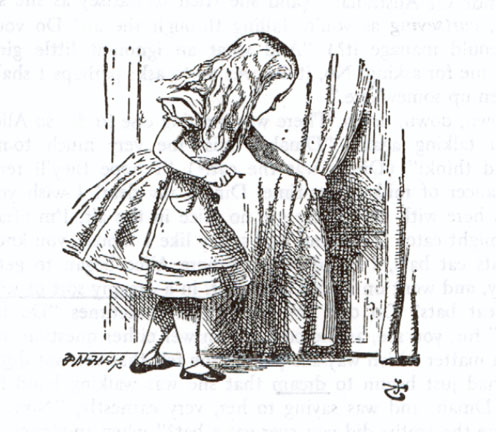
Chapter VIII
A Mad Tea Party
Adaptions from Lewis Carroll
There was a large party table set in front of the Capital, and the March Army and the Gingrinch who stole America were having tea on it: an Alaskan Barracuda was sitting between them, reading notes scribbled on the palm of her hand. "Very uncomfortable for the Barracuda, thought Christine, only, as it sleeps in rational thought, I suppose it doesn't mind.
"Take some money," the March Army said in an encouraging tone.
Christine looked all around the party table, but there was nothing on it but tea."I don't see any money, she remarked"
"There isn't any," said the March Army.
"Then it wasn't very civil of you to offer it," said Christine angrily.
"It wasn't very civil of you to sit down at our party table without being invited, said the March Army.
"I didn't know it was your party,' said Christine; `it's laid for a great many more than three.'
"You should learn not to make personal remarks to provocative questions," the Barracuda said raising her eyes from her palm studies; "the liberal media is very rude."
The Gingrinch opened his eyes very wide on hearing this; but all he said was, "Why is a liberal like a writing-desk?"
"Come, we shall have some fun now!' thought Christine. "I'm glad they've begun asking riddles.--I believe I can guess that," she added aloud.
"Do you mean that you think you can find out the answer to it?" said the March Army.
"Exactly so," said Christine.
"Then you should say what you mean," the March Army went on.
"I do," Christine hastily replied; "at least--at least I mean what I say--that's the same thing, you know."
"Not the same thing a bit!" said the Gingrinch. "You might just as well say that,'The people vote for whom they want' is the same thing as 'The people want for whom they vote.'
"You might just as well say," added the March Army, "that 'Conservatives want what they get' is the same thing as 'Conservatives get what they want!'
`You might just as well say," added the Barracuda, who seemed to be talking in her sleep, "that ' Congress controls the money' is the same thing as ' money controls Congress!'
"It is the same thing with you," said the Gingrinch, and here the conversation dropped, and the party sat silent for a minute, while Christine thought over all she could remember about liberals and writing-desks, which wasn't much.
Christine felt dreadfully puzzled. The Tea Party's remarks seemed to have no sort of meaning in it, and yet it was certainly English. "I don't quite understand you," she said, as politely as she could.
"Have you guessed the riddle yet?" the Gingrinch said, turning to Christine again.
"No, I give it up," Christine replied: "What's the answer?"
"I haven't the slightest idea," said the Gingrinch.
"Nor I," said the March Army.
Christine sighed wearily. "I think you might do something better with the time," she said, "than waste it in asking riddles that have no answers."
"If you knew Time as well as I do," said the Gingrinch, "you wouldn't talk about wasting it. It's him."
"I don't know what you mean," said Christine.
"Of course you don't!" the Gingrinch said, tossing his head contemptuously. "I dare say you never even spoke to Time!"
"Perhaps not," Christine cautiously replied: "but I know time is on my side until the November elections."
"Ah! that accounts for it," said the Gingrinch. "He won't stand beside you. Now, if you only kept on good terms with him, he'd do almost anything you liked with the clock. For instance, suppose it were seven o'clock on the morning of the elections, just time for you to vote for yourself only: you'd only have to whisper a hint to Time, and round goes the clock in a twinkling! Nine o'clock, voting booths closed!"
"That would be grand, certainly,' said Christine thoughtfully. "Is that how you manage?"
The Gingrinch shook his head mournfully. `Not I!' he replied. `We quarrelled near the end of the last administration--just before he went mad, you know--' (pointing with his tea spoon at the March Army,) `--it was at the final dinner given by the First Lady from Midland, and I had to sing
'Twinkle, twinkle, Lone Star State!
WE win when we deregulate!'
"You know the song, perhaps?"
"I've heard something like it," said Christine.
"It goes on, you know," the Gingrinch continued, `in this way:--
'Up above the United States,
Cries from Tea Party delegates.
Twinkle, twinkle--'
Here the Barracuda shook itself, and began singing in its sleep `Twinkle, twinkle, twinkle, twinkle--' and went on so long that they had to pinch it to make it stop.
"Well, I'd hardly finished the first verse,' said the Gingrinch, `when the First Lady jumped up and bawled out, "He's murdering the party! Tax his estate!"
"How dreadfully savage!" exclaimed Christine.
"And ever since that," the Gingrinch went on in a mournful tone, "he won't do a thing I ask! It's always December 16,1773, now."
A bright idea came into Christine's head. "Is that the reason so many tea-things are put out here?" she asked.
"Yes, that's it," said the Gingrinch with a sigh.
"Suppose we change the subject,' the March Army interrupted, yawning. "I'm getting tired of this. I vote the young lady tells us a story."
"I'm afraid I don't know one," said Christine, rather alarmed at the proposal.
"Then the Barracuda shall!" they both cried. "Wake up, Barracuda!" and they pinched it on both sides at once.
The Barracuda slowly opened her eyes. "I wasn't asleep," she said in a hoarse, feeble voice: "I heard every word you fellows were saying."
"Tell us a story!" said the March Army.
"Yes, please do!" pleaded Christine.
"And be quick about it," added the Gingrinch, "or you'll be asleep again before it's done."
"Once upon a time there was a little sister," the Barracuda began in a great hurry; "and she lived on campaign contributions--"
"She couldn't have done that, you know," Christine gently remarked; "it would defy social norms."
"So she was,' said the Barracuda; very defiant."
Christine tried to fancy to herself what such an extraordinary way of living would be like, but it puzzled her too much, so she went on: "But why did she live on campaign contributions?"
"Take some more tea," the March Army said to Christine, very earnestly.
"I've had nothing yet,' Christine replied in an offended tone, "so I can't take more."
"You mean you can't take less," said the Gingrinch: "it's very easy to take more than nothing."
"Nobody asked your opinion," said Christine.
"Who's making personal remarks now?" the Gingrinch asked triumphantly.
Christine did not quite know what to say to this: so she helped herself to some tea, and then turned to the Barracuda, and repeated her question. "Why did the little sister live on campaign contributions?"
The Barracuda again took a minute or two to think about it, and then said, "To prove that earnings should not be taxed.'
"That's ridiculous!" Christine was beginning very angrily, but the Gingrinch and the March Army went `Sh! sh!' and the Barracuda sulkily remarked, "If you can't be civil, you'd better finish the story for yourself."
"No, please go on!" Christine said very humbly.
The Barracuda consented to go on. "And so the little sister-- she was learning to speak in public, you know--"
"What did she say to the public?" said Christine, quite forgetting her promise.
"Taxes are wrong," said the Barracuda, without considering at all this time.
Christine did not wish to offend the Barracuda again, so she began very cautiously: "But I don't understand."
"The little sister was a Kenya channeler." The Gingrinch interjected.
"That holds no water!" Christine suggested.
"The English channel holds water." said the March Army.
This answer so confused poor Christine, that she let the Barracuda go on for some time without interrupting it.
"The little sister was learning to speck in public," the Barracuda went on, yawning and rubbing its eyes, for it was getting very sleepy; "and she spoke of taxes on all manner of things--everything that begins with an M--"
"Why with an M?" said Christine.
"Why not?" said the March Army.
Christine was silent.
The Barracuda had closed its eyes by this time, and was going off into a doze; but, on being pinched by the Gingrinch, it woke up again with a little shriek, and went on: "--that begins with an M, such as money, and mansions, and mistresses, and muchness-- did you ever speak publicly against taxes on muchness?"
"Really, now you ask me,' said Christine, very much confused, `I don't think--"
"Then you shouldn't talk," said the Gingrinch.
This piece of rudeness was more than Christine could bear: she got up in great disgust, and walked off; the Barracuda fell asleep instantly, and neither of the others took the least notice of her going, though she looked back once or twice, half hoping that they would call after her: the last time she saw them, they were trying to put the Barracuda into the teapot.
"At any rate I'll never go there again!" said Christine as she picked her way through the wood. "It's the stupidest tea-party I ever was at in all my life!"
Next week I'll return my focus on the characters from Benson's House, with a look at one of the first nonfictional characters introduced in the story; a writer influenced by his life at sea.
Thursday, September 9, 2010
Rage against the Empire
William Safire would have certainly criticized my use of the verb dumifying- when addressing the current national culture epidemic as the Dumifying of America. It is certainly a bastardization of the English language. Sorry Ms. Dowd- no intentions to offend, but I don't care. Hey,that's what I do. I'm a self proclaimed scholar of pop culture, entitled to take liberties in shaping the psyche of America with semantic liberty. Isn't that what the America Dream is currently all about? Aren't we told by Tony Robbins that one should not allow intimidation to our importance in life? I possess the ideal expressions of everyman. My adamant pronounced self interests are the defining tenets of the people, and, therefore, all contradictions to my values must be condemned as irrelevant and mocked or, more importantly, eliminated from society.
Bravo Tony Robbins; NLP has awakened the giant within. I am king ding-a-ling; hear me roar!I'm a WASP male, therefore, all other cultures, ethnicity, religions, and sexes must be inferior. I must not cater to learning from opposing values or attributions, for that would compromise my own. I must stay ignorant in order to preserve my superiority. I must not shake hands with the little green man from Mars, for they have come to earth to rape my children and begin a cross breeding that will topple my Tony Robbins endorsed superiority. I hate your Martian ambitions to degrade me and take over my universe.
I'm not suggesting Robbins intentionally set out to advocate this distorted logic. I'm implying regions of America have accepted his celebrity to pattern a distorted logic of their own self avocation. The 41st President didn't help matters much with his "either your wit' us, or ag'in' us" rhetoric. The Dumifying of America has taken hold of the wheel of the machine, as it speeds through the labyrinth of America, with enlightenment and logic, panicking, in the back seat of the vehicle.
I was educated in an elementary school environment, patterned after the Summerhill Academy, where I was taught to break free from coercion. I was encouraged to live life independent of the aspirations of others, including my parents, and was encouraged to challenge authority and test the accountability of absolute truths. It is the road that leads to enlightenment, but along the byways stand critics determined to direct the flow of traffic, who define all pursuits alien to their own as rebellious acts of defiance.
Although my parents were devoted Episcopalians, I'm relieved they weren't rigid disciplinarians of the Bible in the strictest sense. For the principals taught in my school would have violated the commandments of the Lord: Deuteronomy 22; verse 18-21, and I would have assuredly been stoned by the elders of my father's city. I'm also relieved the students of the Dumifying of America have not condemned the Bible for its abomination of their own chosen lifestyles: Leviticus 20; verse 27- don't shave your head; Leviticus 20; verse 28- no tattoo's; Deuteronomy 14; verse 8- no pig roasts; Exodus 2o; verse 10- no football on Sunday. There's lots of violence, avarice, corruption and other misconducts proclaimed in the Old Testament, but I wouldn't want the masterpiece seen thrown into the fire.
It would not be the Christian thing to do.
It is 9-11; nines years from that horrid morning when America's routine was disrupted by senseless acts of violence. It was an attack on our soil; a rage against the empire, but not against the republic. There is a distinction.
Factions in third world countries react violently to America the Empire's global expansion, fearing American dominance will destroy their way of life, while many citizen of those same countries long to gain access to the freedoms of America the Republic. They seek the place former President Reagan described as "the shining city on a hill, built on rocks stronger than oceans, wind-swept, God-blessed, and teeming with people of all kinds living in harmony and peace. A city with free ports that hum with commerce and creativity, and if there had to be city walls, the walls had doors and the doors were open to anyone with the will and the heart to get here."
I believe book burnings have ways of closing those doors.
Those opposing a mosque being built blocks from the site of the 9-11 destruction are wrong. Go home. Build a cathedral across the street from the building; temples next store. Turn the entire Battery Park area into a religious exchange where ideals of enlightenment can be tested and challenged, where new theologies can be spawned and new understandings of God's relationship with man can be mastered. You cannot alter defiance with animosity; passion begets compromise. You cannot champion bigotry with rage; only love can conquer hate. Let us not forget those lost souls of varying cultures, ethnicity, religions, and sexes that were lost on this day nine years ago. Let us remember them, this day, in the spirit of peace!
"No one is wise enough or good enough to mould the character of any child. What is wrong with our sick, neurotic world is that we have been moulded, and an adult generation that has seen two great wars and seems about to launch a third should not be trusted to mould the character of a rat"
A.S. Neill
Bravo Tony Robbins; NLP has awakened the giant within. I am king ding-a-ling; hear me roar!I'm a WASP male, therefore, all other cultures, ethnicity, religions, and sexes must be inferior. I must not cater to learning from opposing values or attributions, for that would compromise my own. I must stay ignorant in order to preserve my superiority. I must not shake hands with the little green man from Mars, for they have come to earth to rape my children and begin a cross breeding that will topple my Tony Robbins endorsed superiority. I hate your Martian ambitions to degrade me and take over my universe.
I'm not suggesting Robbins intentionally set out to advocate this distorted logic. I'm implying regions of America have accepted his celebrity to pattern a distorted logic of their own self avocation. The 41st President didn't help matters much with his "either your wit' us, or ag'in' us" rhetoric. The Dumifying of America has taken hold of the wheel of the machine, as it speeds through the labyrinth of America, with enlightenment and logic, panicking, in the back seat of the vehicle.
I was educated in an elementary school environment, patterned after the Summerhill Academy, where I was taught to break free from coercion. I was encouraged to live life independent of the aspirations of others, including my parents, and was encouraged to challenge authority and test the accountability of absolute truths. It is the road that leads to enlightenment, but along the byways stand critics determined to direct the flow of traffic, who define all pursuits alien to their own as rebellious acts of defiance.
Although my parents were devoted Episcopalians, I'm relieved they weren't rigid disciplinarians of the Bible in the strictest sense. For the principals taught in my school would have violated the commandments of the Lord: Deuteronomy 22; verse 18-21, and I would have assuredly been stoned by the elders of my father's city. I'm also relieved the students of the Dumifying of America have not condemned the Bible for its abomination of their own chosen lifestyles: Leviticus 20; verse 27- don't shave your head; Leviticus 20; verse 28- no tattoo's; Deuteronomy 14; verse 8- no pig roasts; Exodus 2o; verse 10- no football on Sunday. There's lots of violence, avarice, corruption and other misconducts proclaimed in the Old Testament, but I wouldn't want the masterpiece seen thrown into the fire.
It would not be the Christian thing to do.
It is 9-11; nines years from that horrid morning when America's routine was disrupted by senseless acts of violence. It was an attack on our soil; a rage against the empire, but not against the republic. There is a distinction.
Factions in third world countries react violently to America the Empire's global expansion, fearing American dominance will destroy their way of life, while many citizen of those same countries long to gain access to the freedoms of America the Republic. They seek the place former President Reagan described as "the shining city on a hill, built on rocks stronger than oceans, wind-swept, God-blessed, and teeming with people of all kinds living in harmony and peace. A city with free ports that hum with commerce and creativity, and if there had to be city walls, the walls had doors and the doors were open to anyone with the will and the heart to get here."
I believe book burnings have ways of closing those doors.
Those opposing a mosque being built blocks from the site of the 9-11 destruction are wrong. Go home. Build a cathedral across the street from the building; temples next store. Turn the entire Battery Park area into a religious exchange where ideals of enlightenment can be tested and challenged, where new theologies can be spawned and new understandings of God's relationship with man can be mastered. You cannot alter defiance with animosity; passion begets compromise. You cannot champion bigotry with rage; only love can conquer hate. Let us not forget those lost souls of varying cultures, ethnicity, religions, and sexes that were lost on this day nine years ago. Let us remember them, this day, in the spirit of peace!
"No one is wise enough or good enough to mould the character of any child. What is wrong with our sick, neurotic world is that we have been moulded, and an adult generation that has seen two great wars and seems about to launch a third should not be trusted to mould the character of a rat"
A.S. Neill
Subscribe to:
Posts (Atom)